Wednesday, August 15, 2012

Mermaids in Comics 2 – The Little Sea Maid

 This was one of my favourite books when I was little. It came to me dog-eared and second-hand. There is an inscription on the inside page opposite the title page with the names of four sisters who used to be my baby-sitters so I am assuming it belonged to them and they gave it to me as a gift.

The book is called Children's Favourite Stories in Pictures. There are no authors' or illustrators' names attached to it. There is no year of publication. There is no copyright information. The publisher is Consolidated Press in Sydney. It looks like it was published in the 1950s. It has an orange cover with illustrations of daisy chain around the title but with berries instead of daisies. In the four corners are four spot illustrations including a horse and rider, as well as a dwarf plus two others that are difficult to see. The inside contains 28 stories, ranging from Greek mythology to Aesop's fables to tales from the Arabian Nights. Some are rendered in colour; others in black and white.

Why is this significant?

Most of the stories are told through sequential art. The panels are wordless, and the text is underneath but they fall under the definition of comics simply because of the sequential art. And most significantly, one of the stories is "The Little Mermaid", although it is called "The Little Sea-Maid".

This, of course, was my favourite story in this book of favourites. The images are gorgeous. They're inked.

Here's what I found online about this book:

1950? Children's Favourite Stories in Pictures. No author or illustrator acknowledged. Sydney: Consolidated Press Ltd. $2.70 somewhere in Colorado, March, '94.
This large-format book is unusual in a number of respects. First, it is one of the very few books I have from Australia. Second, it includes an unusually broad range of material, from Greek myths to Australian aboriginal folklore. Aesop is given two three-page sections: 23-25 and 87-89. Three fables are presented on each page with text and illustration equal in size and alternating columns with each other. On 89, the fables switch finally to color. The illustrations of the second set (87-89) seem to me superior in their artistry; they remind one of Boris Artzybasheff.
Source: http://www.creighton.edu/aesop/books/individualbooksbydate/1950to1954/index.php


The National Library of Australia also has it catalogued.

I think mermaid collectors would be hard-pressed to find this book on the antiquarian book market but you can try.

I've scanned in three of the six pages in the story—the ones that feature the sea maid in mermaid form and where the tail is prominent. The pages are not in sequential order.

I'll lend the book to Jozef so he can scan the entire story for his mermaid art archive. I'm sure he'll be thrilled.


Elf~Fin Leaks and Peeks 28

That's Spax, Hyfus and Razbi in case  anyone wants to know. We wonder what they're looking at? You'll find out very soon with the imminent release of the first issue of Elf~Fin: Hyfus & Tilaweed.

Mermaids in Folklore and Australian Indigenous Culture – Guest Blog by Vanessa Witschi


Mermaids in Folklore
Mermaids are present in the folklore of many cultures around the world. They can be found in Native American culture, Ancient Greek and Roman cultures, as well as in Asia (particularly China, Japan, Indonesia and the Philippines), Russia, Finland, France, Spain, the British Isles and India.

One of the most interesting, although perhaps not as obvious facts, is that mermaids appear in Indigenous Aboriginal culture. 

Separated by water for thousands of years, mermaids appear as an important factor in many of the language and cultural groups spread across Australia. Interestingly, for a country surrounded by oceans and seas, mermaids are largely portrayed as freshwater creatures living in rivers, lakes and billabongs.

How Mermaids are Portrayed in Different Cultures
Some cultures depict mermaids as meek benevolent beings, others as possessors of medical knowledge or as unlucky omens bringing disasters.

Both the Indian and Greek folklore see mermaids as Goddesses—some of whom were originally in a human form but were made half-fish as a punishment from the Gods, and some who always existed in mermaid form. 

Commonly, mermaids (in particular the sirens who were depicted in two forms – mermaid-like and also bird-like) are portrayed as malevolent creatures that sang or played music to lure sailors towards cliffs and death by drowning. These depictions often have their origin in early Greek, Roman or Spanish civilisations. 

In early Russian culture it was believed that women who had died violently or by their own hand lived at the bottom of rivers and mesmerised men to lure them into the river to drown them.

Even today, many cultures still believe in the existence of mermaids. In February 2012, it was reported in the UK Daily Mail, that the Water Minister for Zimbabwe announced that there were delays in building two reservoirs due to mermaids hounding the workers away. It was believed that performing rituals and sacrifices would encourage the mermaids to leave the workers alone. 

The Australian Aborigines of today also believe that mermaids still exist in their waters and rivers.  In some Northern Territory regions, mermaids were believed to instruct women in ceremonial procedures in early Dreamtime, particularly those procedures related to fertility. It was believed that they were still present in many areas and could be seen sitting on rocks but would quickly jump back into the water if they saw anyone coming.  

Another Aboriginal story tells of a man who set a trap to capture a mermaid who he then tied to a tree. He treated her very kindly and eventually she agreed to be his wife. They had children together but she one day disappeared into the river after being reminded of her mermaid form when she saw her reflection in the water.

There is also a belief in some Aboriginal language groups that albino children born to Aboriginal parents are the result of mermaid blood in their ancestry.

A Torres Strait Islander Dreamtime story tells of how fishermen caught a mermaid in their nets. The mermaid warned them not to over-fish the lake and to just to take what they needed for their family. The fishermen continued to over-fish the lake so the mermaid consequently drowned them.

Mermaids in Australian Aboriginal Art
There are a number of modern Aboriginal paintings depicting mermaids, which are held in national museums and art galleries around Australia. Perhaps the most famous are the Yawk Yawk (mermaid) sculptures held in The National Museum of Australia's collection from Western Arnhem Land. These modern woven pandanus sculptures depicting mermaid spirits are by artists Lulu Laradjbi and Marina Murdilnga.


Woven pandanus yawkyawk sculptures by Kunwinjku artists Marina Murdilnga, left, and Lulu Laradjbi. These mythical beings have the tails of fish and hair resembling algal blooms. Photos: Dragi Markovic.

One Aboriginal artist from the Central Arnhem Land (Darnkorlo clan, Yirridjda moiety, Ngarridj subsection, Kunwinjku language), Owen Yalandja creates sculptures and paintings almost exclusively based on the Yawk Yawk (mermaid) spirits near Barrihdjowkkeng. 

Here is one of the first carvings he ever did of a mermaid in 1993, which won the 10th National Aboriginal Art Award that year. The work is held in the Maningrida Arts and Culture Centre in the Northern Territory. 

Source: http://natsiaadigitisation.nt.gov.au/docs/index.php?typ=artwork&p1=ABETH-3121

There are also several modern Aboriginal artworks for sale that depict mermaids including this painting by artist Edie Blitner from the Kimberley area of Western Australia. 


Source: http://arthousebroome.com.au/on-line-store/Kimberley-Art/kimberley-fine-art/eddie-blitner/mermaid-spirit

And this by Northern Territory artist Chris Liddy / Moonggun who notes that when someone drowns it means their spirit was taken by mermaid Mimi spirits. The first one is called Mermaid Mimi Spirits and Crocodile.


Source: http://aboriginalartdreaming.com/site/index.phppage=shop.product_details&flypage=shop.flypage&product_id=17&option=com_virtuemart&Itemid=1&vmcchk=1&Itemid=1


The second one by Chris Liddy / Moonggun is called Mermaid and Mimi Spirits.


Source: 
http://aboriginalartdreaming.com/site/index.phppage=shop.product_details&flypage=shop.flypage&product_id=17&option=com_virtuemart&Itemid=1&vmcchk=1&Itemid=1
  
And you can also find some more Yawk Yawk spirit painting by West Arnhem Land Kunwinjku artist Lesley Nawirridj below. They are both called Mermaid (Yawk Yawk) in the Billabong.


Source:  http://www.kunwinjku-aboriginal-art.com/aboriginal-art-water.html
You can buy some of these magnificent original paintings and printes at their respective galleries. Just follow the links attached to each piece to find out about the artist, the painting and the price!


Vanessa Witschi is a polymer clay artist who creates one-of-a-kind dreaming mermaid sculptures. These collectable mermaids are perfect for little girls, girls at heart and those who truly feel the magic of mermaids!

Saturday, July 21, 2012

Elf~Fin Leaks and Peeks 27

A slightly different snapshot than you're used to... more to come in the upcoming weeks. But more importantly, the first issue of Hyfus & Tilaweed is coming soon.

Tuesday, July 10, 2012

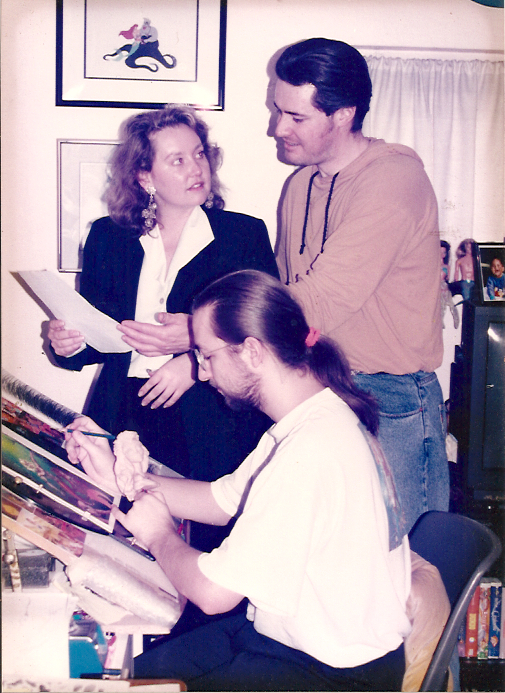
Photos 1 – The BMP (Classic) Team

We thought we might post a series of nostalgic Black Mermaid Productions (BMP) photos so you can check out what we've been up to through the years—this one is of the Classic team, which included co-writer Bruce Love. This photo was taken in Bruce and Jozef's Darlinghurst apartment in Sydney during the early 90s when we were working on ElfQuest: WaveDancers. Julie lived in Balmain and Birchgrove, which was about 15 minutes away. Most of our creative work was done from the couch with quick sojourns to Jozef's drawing desk where he sketched or painted away. It was a great creative partnership and we bounced ideas around with relish. It's fabulous when a team is on the same wavelength. 


Bruce left in 2003 and is doing wonderfully well in his chosen field. Jozef and Julie are focusing on Elf~Fin as you know. We were fresh-faced, young and naive when we started and now we're a little more seasoned. We also look a little different as one would expect—Jozef's hair is short and Julie has gone from dark blonde to red. 


This photo has been framed in Julie's office all these years, and today is the first time it's been scanned and released on our blog. We'll have more for you soon.

Wednesday, July 4, 2012

Elf~Fin Leaks and Peeks 26

This is Lyban and Fillayne. We wonder what got her attention... Find out in the first issue of Elf~Fin: Hyfus & Tilaweed to be released in a few months time.

New Book by ‘Hippo’ Author Helps You Become an "Authorpreneurs"


A new book by renowned children’s author Hazel Edwards (and supporter of all things comics on the Australian scene!), has just been published to help writers, illustrators and comics creators build sustainable careers in a rapidly changing industry. Best known for her book There’s a Hippopotamus on Our Roof Eating Cake, Edwards’ latest title Authorpreneurship: The business of creativity shows authors how they can invest in their creativity to increase their professional opportunities.
Today’s creator needs to be an ‘authorpreneur’—an originator and an entrepreneur. Apart from crafting words or images for specific audiences, this means learning the marketing, publicity, technological, legal and entrepreneurial skills to establish and maintain. Authors have become small businesses, so they need new tools to maximise their business opportunities. They also need support to adapt to a fast-changing, digital, global industry.  

This practical book offers strategies for beginner, mid-list and highly experienced creators to help sell work for longer, in varied new formats and to larger audiences by: 
  • Building an author brand
  • Networking in person and online
  • Becoming a strategic thinker
  • Writing effective proposals
  • Costing your time
  • Delegating or collaborating
  • Developing effective business systems.
It includes checklists, hints, case studies and hypothetical scenarios to help authors explore the situations they might encounter as an authorpreneur.

Published by Keesing Press, the print book is available for $24.95 through the Australian Society of Authors’ website.

The e-book will be available from Hazel Edwards' website in a month.